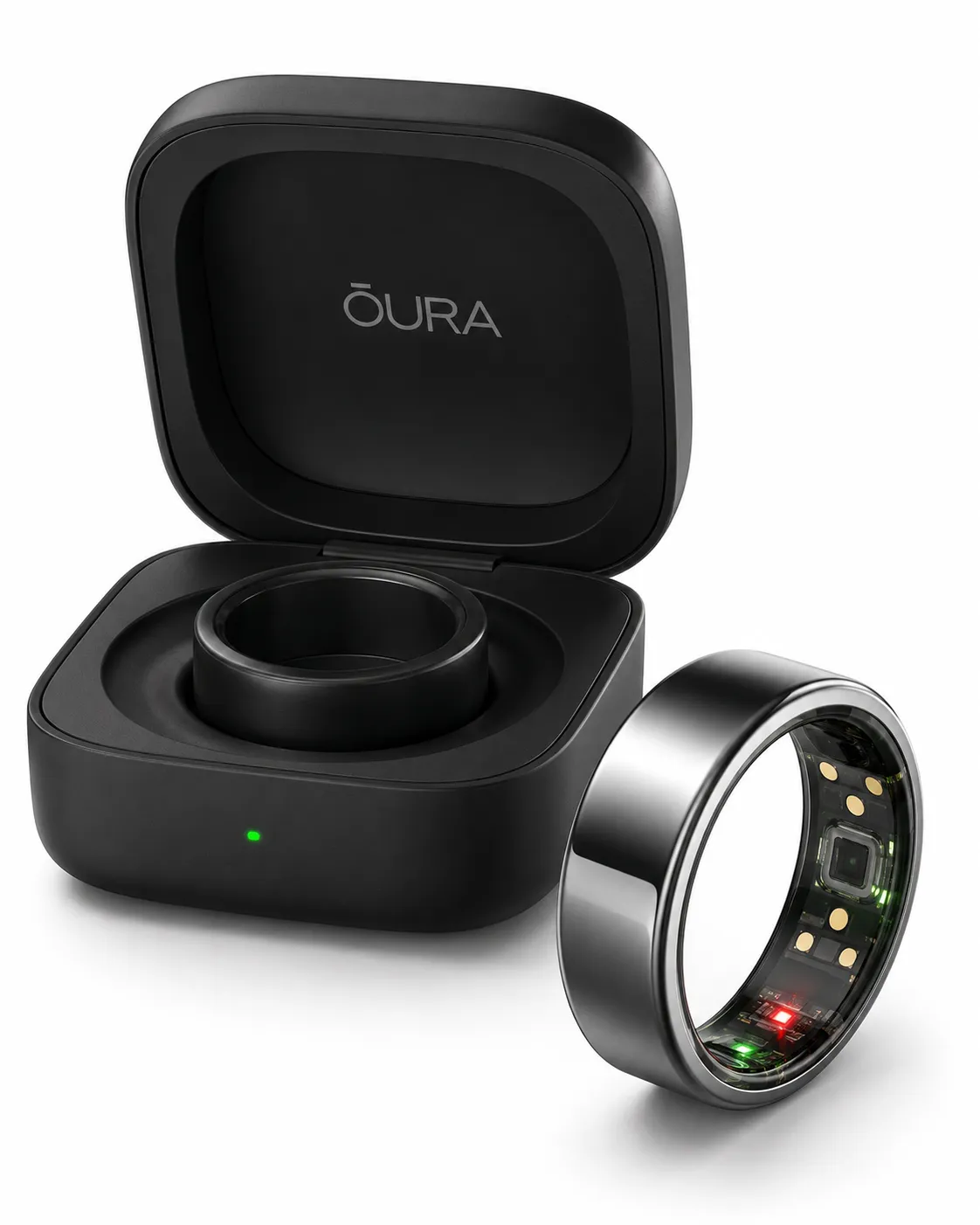
Smart Ring Health Tracker
A screenless health-tracking ring that's quietly taken over the wearables category — smart rings now account for 75% of all US fitness-tracker revenue, up from under half a year earlier.
A smart ring packs the same sensors as a fitness watch — heart rate, sleep staging, skin temperature, activity — into a form small enough to wear to bed comfortably, which is exactly the use case that's driven its recent boom. Oura effectively created and still dominates the category, but competition from Samsung, Ultrahuman, and RingConn has grown quickly.
An 11-year-old product that suddenly exploded
Oura launched its first ring in 2015 and spent roughly a decade building a loyal, sleep-tracking-focused following before growth accelerated sharply — the company sold more rings in the twelve months after June 2024 than in its first eleven years combined, crossing 5.5 million total units sold and pushing 2024 revenue past $500 million, more than double 2023.
Circana market data shows just how fast the wider category has shifted: smart rings jumped from 46% to 75% of total US fitness-tracker revenue in a single year, a move largely at the expense of traditional fitness bands and smartwatches.
Why a ring instead of a watch
The core appeal is comfort during sleep — a screenless ring is far less intrusive to wear to bed than a watch, and sleep-tracking accuracy is specifically what independent studies have found Oura outperforms competing wrist wearables on. No screen also means dramatically better battery life, typically 4–7 days per charge versus 1–2 for most smartwatches.
Competition has picked up fast: Samsung entered with the Galaxy Ring, and Ultrahuman has reached full-year profitability of its own — though both of Oura's next-biggest rivals, Ultrahuman and RingConn, were facing a US import restriction tied to a patent dispute as of late 2025, which has arguably helped cement Oura's lead further in the meantime.